
CSSB Trade Show & AGM 2026
October
14-15, 2026
Chicago, IL
Product Types
What Types of Cedar Shake and Shingle Products Are Available?
We organize our Certi-label® products into three families: roof products, sidewall products, and specialty and historical restoration products. Each family covers a different part of a building, and within each one, the choice usually comes down to a split product or a sawn one.
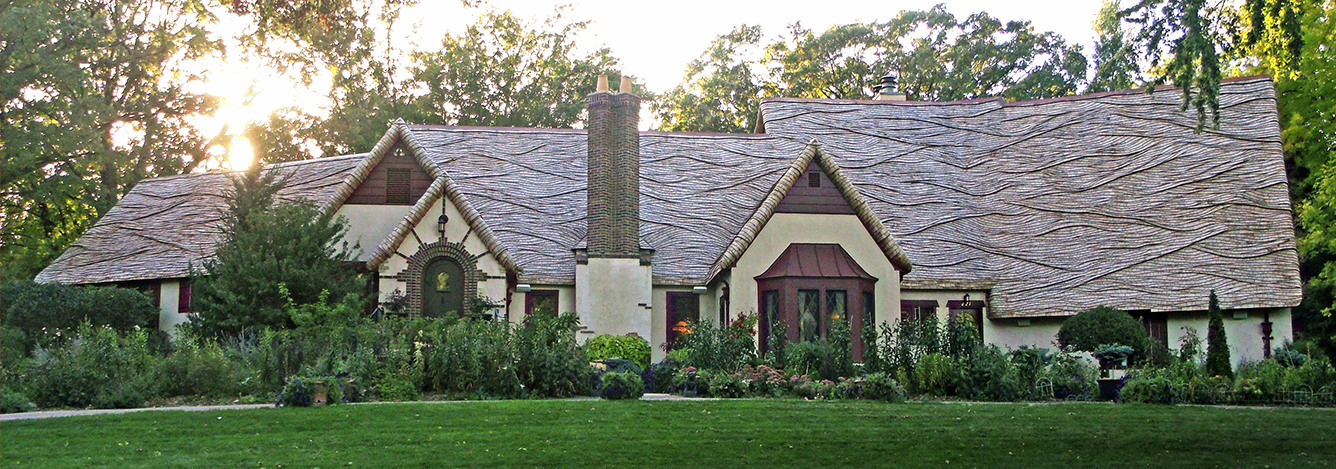
Courtesy: District Managers Tony Hyatt and Peter Parmenter.
Roof Products
A roof carries more of the weather load than a wall does, so the roof product line includes both split and sawn options, plus the ridge caps that finish the job.
Choosing between them usually comes down to how rustic a look the project calls for and how much upkeep the owner is prepared to take on: the split products hold the heaviest shadow lines and the most character, while tapersawn and sawn shingles offer a flatter, more consistent surface. Every option carries a Certi-label® grade, and pairing the field product with matching ridge caps keeps the whole roof consistent from eave to ridge.
Sidewall Products
Sidewalls don’t shed water at a pitch the way a roof does, so the sidewall line is built entirely around sawn shingles rather than split shakes, each cut differently for a particular wall pattern.
Since none of these are split, they lay flatter against the wall substrate than a roof shake would, and that flat profile is exactly what makes tight, patterned coursing possible on a sidewall.
Specialty and Historic Restoration Products
Older buildings were often shingled or shaked with dimensions, cuts, and grades that aren’t part of a standard modern order, so matching them takes more than picking the closest current product off the shelf. Getting the shape, thickness, width, length, and exposure right, along with details like exposed nails or a particular butt pattern, is what makes a restoration read as original rather than patched. Our Member Manufacturers can supply matched cuts and grades for this kind of work, and we recommend involving a Member Contractor or Installer early, since project-specific decisions like exposure and fastener choice are best made on site rather than from a general specification.
Learn More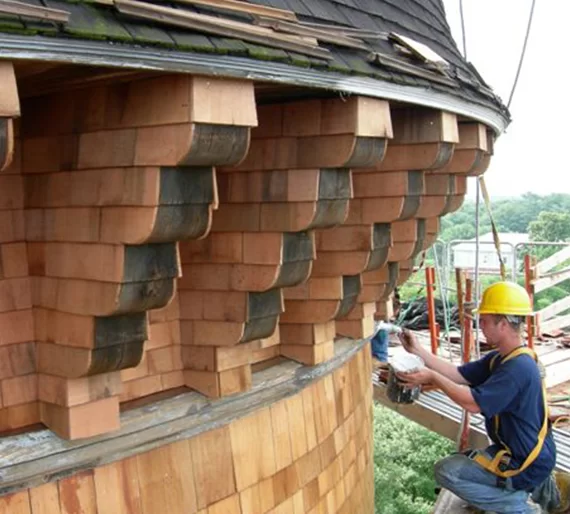
Lawson Tower, February 2013. Photo courtesy of District Manager Tony Bonura.
Frequently Asked Questions
What's the difference between a cedar shake and a cedar shingle?
A shake is split, or split and resawn, so it keeps a natural grain face and a heavier, more irregular profile. A shingle is sawn smooth on both faces for a flatter, more uniform look. Both are graded under Certi-label® rules, and the choice comes down to the shadow line and maintenance level a project wants.
Should I use shakes or shingles on a roof?
Both are used on roofs. Handsplit and resawn or straight-split shakes give the most rustic, heaviest-textured look; tapersawn shakes offer a cleaner but still dimensional surface; and Certigrade® shingles give the flattest, most uniform appearance. All three are graded and installed with a felt interlay between courses for weather protection.
Can I use roof shakes on a sidewall, or sidewall shingles on a roof?
Our sidewall products (Certi-Cut®, Certigroove®, and R&R shingles) are cut and profiled for wall exposure, not roof pitches, and our roof products are graded for roof exposure. It’s best to stick to the product line built for the application, and make sure to check with a Member Manufacturer if a project calls for something unusual.
What does Certi-Ridge® cover?
Certi-Ridge® shingle and shake ridge caps finish the hips and ridges of a roof and are matched to the field product already installed, whether that’s a shingle or a shake, so the transition at the ridge stays consistent with the rest of the roof.
How do I match products for a historic restoration?
Start with the original shape, thickness, width, length, and exposure, since those details drive how faithful the finished roof or wall looks. Our Member Manufacturers can supply matched cuts and grades, and a Member Contractor or Installer can advise on job-site specifics like fastener choice and exposure for that particular building.
Where do I find pricing or place an order?
We’re a trade bureau, not a retailer, so we don’t sell products or quote pricing directly. Use our Find-a-Member directory to connect with a Member Manufacturer or Retailer who can quote your project.